Firewall Ports for AD Domain Join

Joining clients to an Active Directory domain requires specific firewall ports to be open. This updated guide for 2026 covers the minimum and recommended ports for Windows 11/Server 2022+ domain joins, including pfSense firewall configuration examples.
Minimum Required Ports
Windows 11 and Server 2022 clients can join a Windows Server 2022/2025 AD Domain with the following ports allowed through the firewall:
| Port | Protocol | Service | Purpose |
|---|---|---|---|
| 88 | TCP/UDP | Kerberos | Key Distribution Center (KDC) authentication |
| 135 | TCP | RPC | Remote Procedure Call for domain operations |
| 139 | TCP | NetBIOS | Session Service for legacy compatibility |
| 389 | TCP/UDP | LDAP | Directory queries and domain locator |
| 445 | TCP | SMB/CIFS | File sharing, NetLogon, Group Policy |
| 53 | UDP/TCP | DNS | Domain name resolution (critical for DC locator) |
| 464 | TCP/UDP | Kerberos | Password changes (kpasswd) |
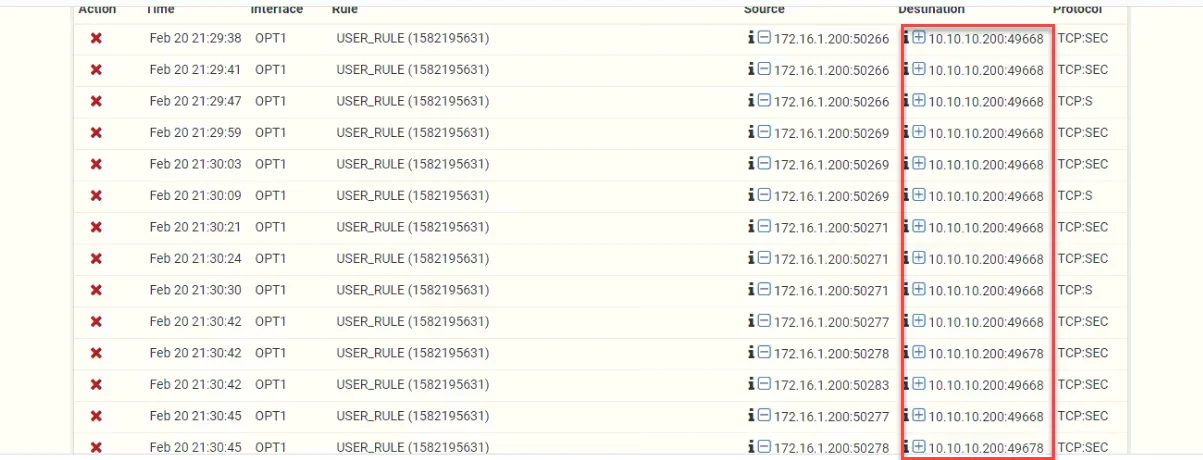
| 49152-65535 | TCP | RPC EPM | Dynamic RPC endpoint mapper (high ports) |
Why High Ports Matter
Without the TCP high ports (49152-65535) open, you may see errors like:
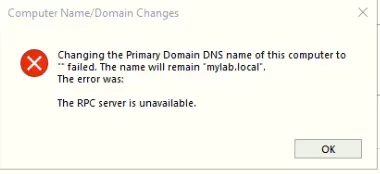
This occurs because Windows uses dynamic RPC ports for various domain operations. The firewall blocks these connections:
Recommended Additional Ports
For full functionality including password changes, time synchronization, and optimal performance:
| Port | Protocol | Service | Purpose |
|---|---|---|---|
| 123 | UDP | NTP | Time synchronization (critical for Kerberos) |
| 137 | UDP | NetBIOS | Name resolution (legacy) |
| 138 | UDP | NetBIOS | Datagram service (legacy) |
| 636 | TCP/UDP | LDAPS | LDAP over SSL/TLS |
| 3268 | TCP | Global Catalog | Forest-wide searches |
| 3269 | TCP | GC SSL | Global Catalog over SSL |
pfSense Firewall Configuration
Step 1: Create Firewall Aliases
Create an alias for your Domain Controllers to simplify rule management:
Firewall > Aliases > Add
Name: DC_IPs
Type: Host(s)
Entries: 192.168.1.10, 192.168.1.11, 192.168.1.12
Step 2: Create Firewall Rules
Navigate to Firewall > Rules > LAN and create the following rules:
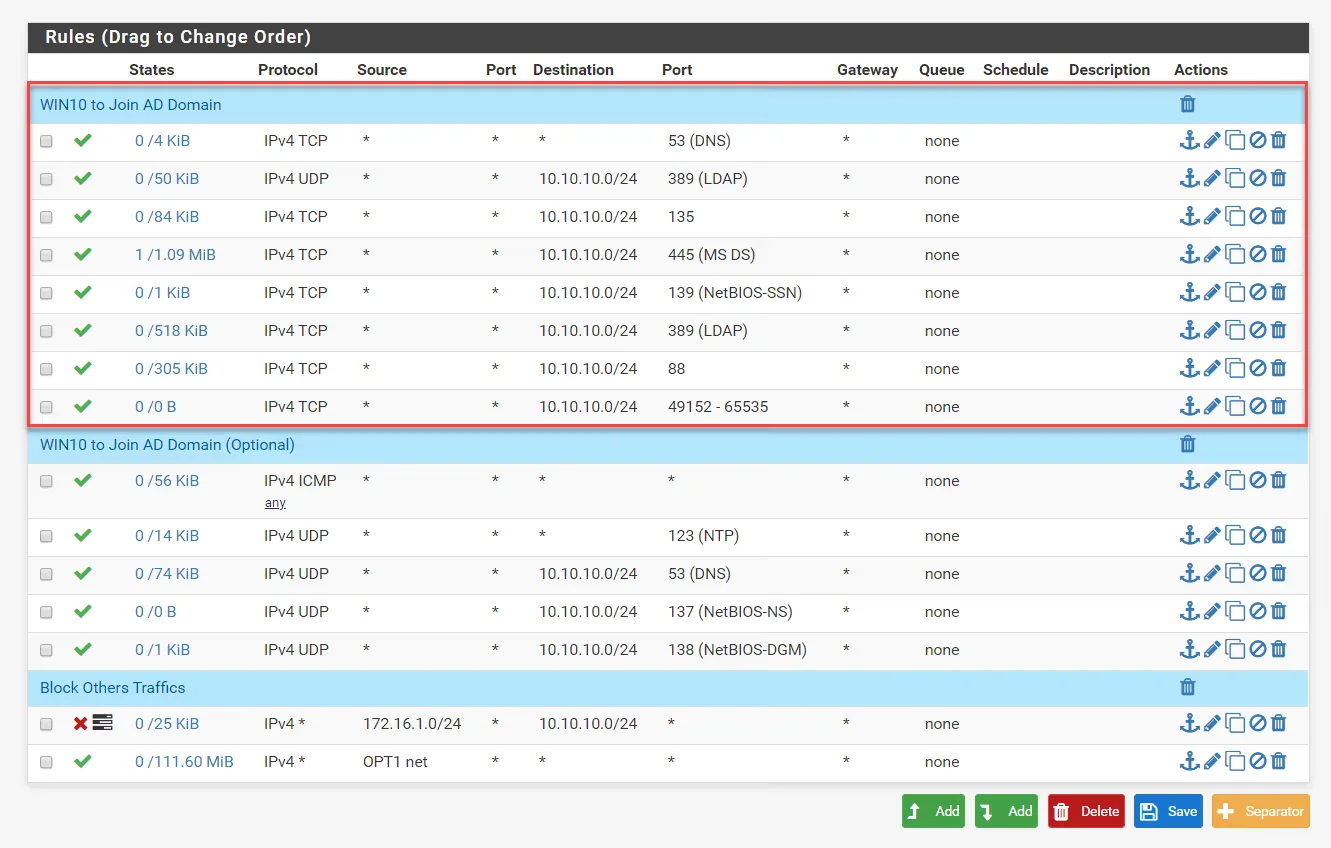
| Rule | Protocol | Source | Destination | Port | Action |
|---|---|---|---|---|---|
| Kerberos | TCP/UDP | * | DC_IPs | 88 | Allow |
| DNS | TCP/UDP | * | DC_IPs | 53 | Allow |
| LDAP | TCP/UDP | * | DC_IPs | 389, 636 | Allow |
| SMB | TCP | * | DC_IPs | 445 | Allow |
| RPC | TCP | * | DC_IPs | 135 | Allow |
| RPC High Ports | TCP | * | DC_IPs | 49152-65535 | Allow |
| NTP | UDP | * | DC_IPs | 123 | Allow |
| Global Catalog | TCP | * | DC_IPs | 3268, 3269 | Allow |
Step 3: Rule Order
Ensure your rules are ordered correctly - more specific rules should be at the top:
1. Allow DNS to DC_IPs (53)
2. Allow Kerberos to DC_IPs (88)
3. Allow LDAP/LDAPS to DC_IPs (389, 636)
4. Allow SMB to DC_IPs (445)
5. Allow RPC to DC_IPs (135, 49152-65535)
6. Allow NTP to DC_IPs (123)
7. Allow Global Catalog to DC_IPs (3268, 3269)
8. Default deny rule
Testing Domain Join Connectivity
Using PowerShell
# Test Kerberos connectivity
Test-NetConnection -ComputerName dc01.mydomain.local -Port 88

# Test LDAP connectivity
Test-NetConnection -ComputerName dc01.mydomain.local -Port 389

# Test SMB connectivity
Test-NetConnection -ComputerName dc01.mydomain.local -Port 445

# Test DNS resolution
Resolve-DnsName -Name mydomain.local -Type SOA

# Test domain join readiness
Test-ComputerSecureChannel -Verbose
Using telnet (if available)
telnet dc01.mydomain.local 88
telnet dc01.mydomain.local 389
telnet dc01.mydomain.local 445
Common Issues and Solutions
Issue: “The specified domain either does not exist or could not be contacted”
Solution: Check DNS configuration. The client must be able to resolve SRV records:
nslookup -type=SRV _ldap._tcp.mydomain.local
nslookup -type=SRV _kerberos._tcp.mydomain.local
Issue: “The network path was not found”
Solution: Verify SMB (port 445) connectivity and that no intermediate firewall is blocking it.
Issue: “The clock skew is too great”
Solution: Ensure NTP (port 123) is open and the client time is within 5 minutes of the DC time.
Issue: Domain join succeeds but with warnings
Solution: This typically indicates high RPC ports are blocked. Add rules for ports 49152-65535.
Security Best Practices
- Restrict Source IPs: Where possible, limit AD firewall rules to specific subnets or VLANs
- Use LDAPS: Prefer LDAPS (636) over plain LDAP (389) for encrypted directory communications
- Monitor Logs: Enable firewall logging for denied packets to troubleshoot connectivity issues
- Segment Networks: Place domain controllers in a dedicated management VLAN
- Regular Audits: Periodically review firewall rules and remove unnecessary access
Windows Server 2025 Changes
Windows Server 2025 introduces enhanced security defaults:
- SMB Signing Required: All SMB traffic must be signed
- LDAP Channel Binding: Enhanced protection against man-in-the-middle attacks
- Kerberos Armoring: Default in Server 2025, requires compatible clients
Ensure your firewall rules accommodate these security enhancements without blocking legitimate traffic.