Oh My Opencode Agents: Sisyphus and the Specialist Crew
The biggest capability jump in OpenCode comes from separating orchestration, planning, execution, and research into specialist agents. Oh My Opencode packages that into a batteries-included harness: Sisyphus coordinating eleven agents with distinct permissions, prompts, and model preferences — where changing an agent’s model changes which prompt fires.
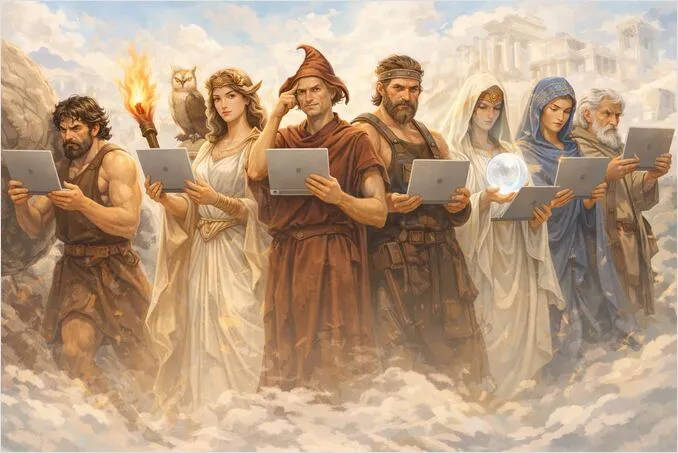 Orchestrators, planners, workers, specialists: one roster, four model families
Four Personality Groups
The foundational idea: different models think differently, and each prompt is written for one mental model. Claude follows mechanics-driven checklists (more rules, more compliance); GPT follows principle-driven concision (a 1,100-line Claude prompt makes GPT contradict itself; a 121-line GPT prompt makes Claude drift). Cross that boundary and output degrades — check family crossings first when agents feel off after model changes.
| Group | Agents | Prompt style | Rule |
|---|---|---|---|
| Communicators (Claude/Kimi/GLM) | Sisyphus, Metis | Long mechanics-driven | Never override to older GPT |
| Dual-prompt (Claude preferred, GPT supported) | Prometheus, Atlas | Auto-switches via runtime detection | Safe either way |
| GPT-native (GPT-5.3-codex / GPT-5.4) | Hephaestus, Oracle, Momus | Principle-driven autonomous | Never override to Claude |
| Utility runners (speed first) | Explore, Librarian, Multimodal Looker | Retrieval and reporting | Never “upgrade” to flagships |
Delegation: Categories Route, Agents Execute
Two mechanisms: task() for category-based delegation (pick deep or visual-engineering, optionally inject skills, optionally background) and call_omo_agent() for direct named invocation bypassing routing. Both parallelize with per-provider and per-model concurrency caps. Categories are model-routing presets, not labels:
| Category | For | Defaults toward |
|---|---|---|
| visual-engineering | Frontend, UI/UX, CSS | Gemini-class models |
| artistry | Creative, novel approaches | Gemini → Claude Opus → GPT |
| ultrabrain | Hard logic, architecture | GPT → Gemini → Claude Opus |
| deep | Complex multi-file coding | GPT Codex → Claude Opus → Gemini |
| unspecified-high / -low | General complex / standard | Opus-led / Sonnet-led chains |
| quick | Single-file, simple tasks | Haiku → Flash → Nano |
| writing | Docs and prose | Flash → Sonnet |
Resolution order per request: explicit user override, then fallback chain, then system default — with provider priority (native, then aggregators and budget tiers) deciding ties. Categories double as the self-hosting seam: map one to a local model and every routed task follows automatically. Whether the orchestration earns its cost is measured in the experience report; install mechanics live in the quickstart.
The Roster
Orchestrators. Sisyphus plans, delegates, and drives completion through aggressive parallelism on a ~1,100-line prompt needing Claude-class instruction following across dozens of tool calls — hardest to self-host, test single-agent first. Atlas todo-drives checklists with dual-prompt auto-switching; structured enough for mid-size local coders at 32k+ context.
Planners (think-before-act). Prometheus interviews scope and ambiguities into verified plans (Tab or /start-work), collaborating with Metis (high-temperature gap detection — keep it non-zero or it rubber-stamps) and Momus (strict OK-or-reject plan gate, GPT-native, sample near zero for reproducible critique).
Workers. Hephaestus takes goals not recipes, exploring and executing end-to-end — GPT-5.3-Codex only, no fallback chain, no local path today (route deep elsewhere instead). Sisyphus-Junior is the category-spawned contractor inheriting its launcher’s model — the most practical self-hosting entry point: map quick first, verify, expand upward before touching deep or ultrabrain.
Specialists. Oracle advises on architecture and last-resort debugging, read-only and delegation-free by restriction — keep on cloud; local reasoning gaps show most here. Librarian sources external docs in parallel with repo exploration — fully local on day one, even small models suffice for search-collect-report. Explore fires scoped parallel codebase searches for orchestrator synthesis — same local-first story with fast small coders. Multimodal Looker reads screenshots, diagrams, and PDFs read-only — keep cloud until local vision plus tool-calling proves itself, since misconfigured vision fails silently.
Self-Hosting Matrix
| Agent | Local viability | Approach |
|---|---|---|
| Explore, Librarian | Excellent | Fast local coder, day one |
Sisyphus-Junior (quick) |
Good | Map category, verify, expand |
| Atlas, Prometheus, Metis, Momus | Workable | 13B+, 32-64k context, tuned temperatures |
| Sisyphus | Partial | Simple single-agent tasks only |
| Oracle | Not recommended | Cloud quality gap matters most here |
| Hephaestus | No local path | Requires GPT-5.3-Codex, no fallback |
Two config layers: OpenCode learns the provider (Ollama/vLLM/OpenAI-compatible baseURL plus model IDs, 64k+ context for orchestrators), then Oh My Opencode assigns agents to models (project .opencode/oh-my-opencode.jsonc over user-level). Practical hybrid: utilities and quick/writing categories local, reasoning agents and deep/ultrabrain on cloud, background concurrency split per provider (local endpoints tolerate more parallelism, metered plans less). Before full self-hosting bills, price the aggregator middle path — budget-tier frontier models covering orchestration around $11/month often undercut GPU ownership without hardware duty.
Built-in Force Multipliers
Hashline tags every read line with a content hash, rejecting edits against changed files before corruption — the whole stale-line error class, gone. /init-deep generates hierarchical AGENTS.md per project level so agents pull scope-relevant context instead of whole repos. Prometheus mode (/start-work) enforces zero-decisions-left planning. Ralph Loop (/ulw-loop) self-verifies to 100% completion on large multi-step work — set concurrency caps first on metered providers. Three MCPs ride along always-on: web search, official docs lookup, and public code search.
Summary
Eleven agents, four model families, category routing over model names, local-first utilities with cloud-kept reasoners. Respect family boundaries, map categories deliberately, and let measurements — not enthusiasm — promote agents to local hosting.
Running the Sisyphus crew — which agent earned its model, and which one did you move local first? Share the roster in the comments below!