Text Embeddings for RAG and Search: Ollama and OpenAI-Compatible APIs
An embedding is a fixed-dimensional float vector placing similar meanings nearby — a representation layer for search, clustering, dedup, and RAG retrieval, not token IDs and not chat output. The concepts stay identical across backends; only the HTTP surface changes. Two local patterns cover nearly everything: Ollama’s embed endpoint and any OpenAI-compatible embeddings route.
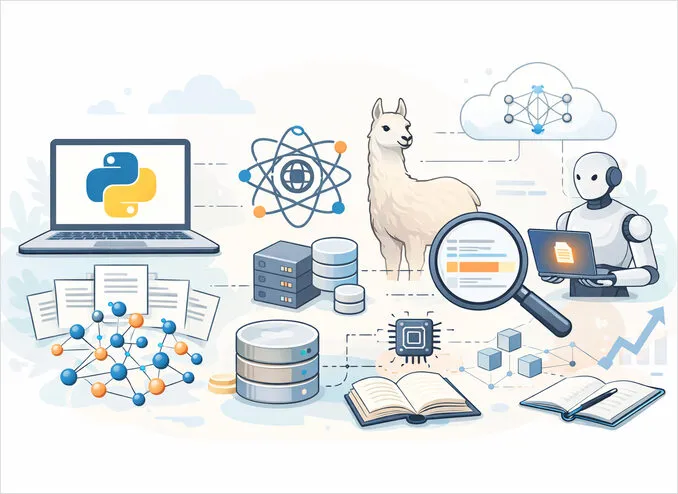 Chunk, embed, index, retrieve text: embeddings choose what the chat model sees
Where Embeddings Sit in RAG
Offline: chunk documents (size, overlap, structure decide quality), embed each chunk with metadata (source, offsets, ACL), index into memory, library, or vector database. Query time: embed the query, retrieve top-k by vector similarity (plus hybrid keyword when terms matter), assemble retrieved plain text into the chat prompt. Critical nuance: chat APIs consume text and tools, never embedding tensors — embeddings select which text to inject. “Query with precalculated embeddings” always means retrieve-then-send-text.
Beyond retrieval: semantic search, cross-encoder reranking of candidates, clustering and dedup without hand labels, prototype-based classification scoring, and multimodal image-text bridging.
Ollama Embeddings in Python
Ollama serves POST /api/embed with model name and string-or-list input, returning aligned vectors:
import httpx

OLLAMA = "http://127.0.0.1:11434"
MODEL = "nomic-embed-text"  # pull your chosen tag first

def embed_ollama(texts: list[str]) -> list[list[float]]:
    r = httpx.post(
        f"{OLLAMA}/api/embed",
        json={"model": MODEL, "input": texts},
        timeout=120.0,
    )
    r.raise_for_status()
    return r.json()["embeddings"]

if __name__ == "__main__":
    qv = embed_ollama(["What is retrieval-augmented generation?"])[0]
    doc_vs = embed_ollama([
        "RAG combines retrieval with generation.",
        "Embeddings map text into vector space for similarity search.",
    ])
    print(len(qv), len(doc_vs), len(doc_vs[0]))
Pull the model tag first, and remember embedding throughput shares Ollama’s scheduling with generation under load.
OpenAI-Compatible Embeddings in Python
llama.cpp-style servers expose POST /v1/embeddings — same concepts, official openai client, pointed locally:
from openai import OpenAI

client = OpenAI(
    base_url="http://127.0.0.1:8080/v1",
    api_key="not-needed",  # many local servers ignore this
)

def embed_openai_compatible(text: str, model: str) -> list[float]:
    r = client.embeddings.create(model=model, input=text)
    return r.data[0].embedding

if __name__ == "__main__":
    print(len(embed_openai_compatible("hello from llama.cpp", "your-embedding-model-id")))
Persist, Query, Rerank
Store vector plus text plus metadata per chunk — prototype in a Python list with NumPy cosine similarity, graduate to FAISS or a vector database as data grows. Query loop stays four steps: embed query, top-k search, join chunk texts, send context plus question to chat. Then rerank: cross-encoders or second scoring models re-ordering vector-retrieved candidates catch what similarity rankings miss.
Summary
Embeddings are the selection layer beneath RAG: chunk deliberately, embed locally through either HTTP surface, persist with metadata, retrieve by similarity, rerank the finalists, and always send text — never tensors — to the chat model.
Which embedding setup serves your retrieval — Ollama, llama.cpp, or hosted APIs? Share the stack in the comments below!