LLM Guardrails in Practice: Control the Risk, Not the Model
Models hallucinate, leak data, emit harmful content, and refuse legitimate requests. Guardrails constrain behavior without removing capability — but only the guardrails that match real risk earn their latency. The discipline is knowing which ones matter and which are noise.
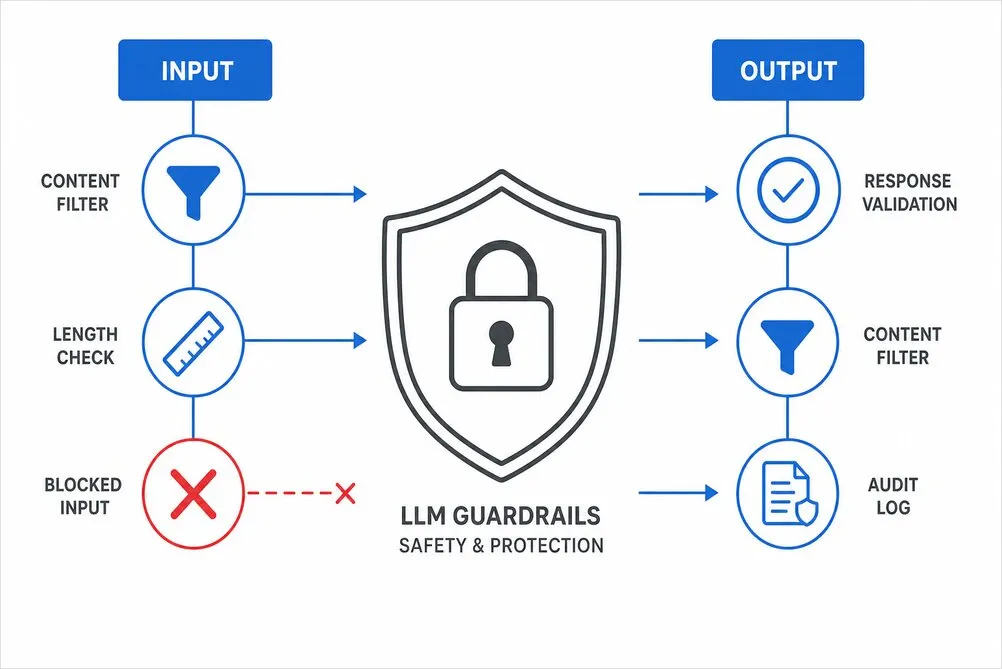 Validate input, filter output, budget the runtime: layered, not decorative
Input Validation First
Bad input produces bad output — and injects it. Sanitize known attack patterns early, accepting that adversarial creativity outruns regex while obvious attempts remain the most common:
import re

class PromptSanitizer:
    def __init__(self):
        self.dangerous_patterns = [
            r"ignore\s+previous\s+instructions",
            r"system\s+prompt",
            r"you\s+are\s+now\s+free",
            r"break\s+out\s+of",
        ]

    def sanitize(self, prompt: str) -> str:
        for pattern in self.dangerous_patterns:
            prompt = re.sub(pattern, "[REDACTED]", prompt, flags=re.IGNORECASE)
        return prompt
Cap lengths against token waste and timeouts, and filter policy-violating topics per domain — string matching for speed, a small classifier model for production accuracy where evasion matters.
Output Filtering: Structure, Content, Facts
Validate shape before meaning. Expecting JSON? Check fields exist:
class ResponseValidator:
    def __init__(self):
        self.required_fields = ["answer", "confidence"]

    def validate(self, response: dict) -> tuple[bool, str]:
        for field in self.required_fields:
            if field not in response:
                return False, f"Missing field: {field}"
        return True, "OK"
Filter harmful patterns on the way out with the same regex-then-classifier escalation. Fact-checking is the hard one: no dictionary scales, so check high-stakes claims against a retrieval pipeline over a knowledge base rather than hardcoded truth — and scope it to claims that matter, not every sentence.
Safety Mechanisms: Rate, Budget, Window
import time
from collections import deque

class RateLimiter:
    def __init__(self, max_requests: int = 10, window: int = 60):
        self.max_requests = max_requests
        self.window = window
        self.requests = deque()

    def allow(self) -> bool:
        now = time.time()
        while self.requests and self.requests[0] < now - self.window:
            self.requests.popleft()
        if len(self.requests) >= self.max_requests:
            return False
        self.requests.append(now)
        return True
Token budgets cap per-request spend; sliding-window trimming prevents context overflow (losing early context — summarization or attention compression preserve more at higher latency). Compliance adds the enterprise pair: data residency checks pinning regions, and structured append-only audit logs capturing request, response, and timestamp for debugging and regulators.
Assemble in Layers
Simple pipeline first — validate input, call model, filter output:
class SimpleGuardrails:
    def __init__(self):
        self.input_validator = InputValidator(max_length=10000)
        self.output_filter = OutputFilter()

    def process(self, prompt: str) -> str:
        valid, message = self.input_validator.validate(prompt)
        if not valid:
            return f"Error: {message}"
        response = self.call_model(prompt)
        valid, message = self.output_filter.filter(response)
        if not valid:
            return f"Error: {message}"
        return response
Advanced stacks add sanitization, domain filtering, rate limiting, and token budgets around the same skeleton. Deploy guardrails for user-facing systems, sensitive data, production traffic, and compliance regimes (GDPR, HIPAA, SOC 2) — skip them for prototypes, internal-only tools, and non-sensitive workloads. Capability always trades against safety; find the system’s balance, not the maximum.
| Strategy | Safety | Capability | Latency |
|---|---|---|---|
| None | Lowest | Highest | Lowest |
| Input validation | High | Medium | Low |
| Output filtering | High | Medium | Low |
| Safety mechanisms | Highest | Lowest | Highest |
| Compliance | Highest | Lowest | Highest |
Beyond the Conversation
Guardrails stop where agency starts. Once agents call MCP tools or delegate across A2A, the risk moves from model output to actions taken on someone’s behalf — identity, scoped authorization, delegation limits, audit trails. That protocol layer is covered in A2A and MCP agent security: polite well-filtered chatbots can still exfiltrate through tool calls without it.
Summary
Sanitize and bound the input, validate structure then content then high-stakes facts on output, rate-limit and budget the runtime, log everything compliance cares about — and leave prototypes unguarded until the bill or the risk arrives.
Which guardrail caught something real in your system — and which one only added latency? Share the tradeoff in the comments below!