PKM vs RAG vs Wiki vs Memory: Four Knowledge Jobs, Four Systems
PKM, wikis, RAG, and AI memory get discussed as rivals solving one problem. They don’t. PKM helps humans think, wikis preserve shared knowledge, RAG retrieves for machines, memory gives agents continuity. Mix them up and you get personal scratch in the wiki, sourceless-truth RAG, database-pretending memory, and automation-bloated PKM.
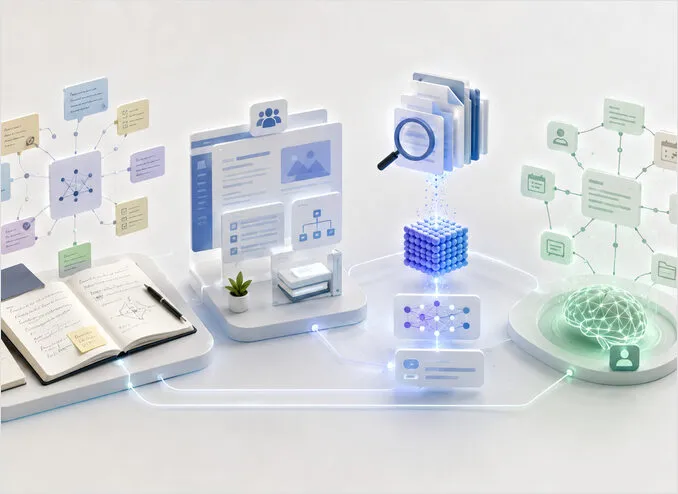 Thinking, shared truth, retrieval, continuity: separate questions, separate systems
The Core Split
PKM and wikis structure knowledge. RAG retrieves knowledge. Memory systems evolve agent context.
They overlap visibly — all store, retrieve, answer, organize, connect — but optimize different knowledge stages: capture, structure, retrieval, interpretation, reuse, evolution. A PKM isn’t a private wiki, a wiki isn’t a RAG database, RAG isn’t memory, memory isn’t documentation.
| Dimension | PKM | Wiki | RAG | AI memory |
|---|---|---|---|---|
| Primary user | Individual | Team / public | AI system | AI agent |
| Function | Thinking | Shared reference | Query-time retrieval | Persistent context |
| Knowledge state | Evolving | Stabilized | Retrieved | Adaptive |
| Structure | Flexible | Explicit | Index-based | Learned / extracted |
| Ownership | Personal | Page / team owners | System maintainers | Agent / user controlled |
| Best output | Insight | Reliable reference | Grounded answer | Continuity |
| Main risk | Hoarding | Staleness | Bad retrieval | Bad memory |
| Metric | Reuse in thinking | Trust and freshness | Answer quality | Helpful continuity |
Four Paradigms in Brief
PKM captures, organizes, connects, and uses knowledge for personal work — learning domains, developing ideas, tracking research, building a second brain. Good PKM stays usefully messy: unfinished thoughts, partial ideas, evolving concepts. Documentation wants clarity; PKM tolerates ambiguity. It fails as dumping ground, taxonomy project, aesthetic, tool hobby, or dead archive — collection without synthesis is a landfill. Optimize for reuse, not capture.
Wikis hold shared reference: runbooks, product knowledge, policies, technical reference, onboarding — a social contract naming where knowledge lives, with owners and maintenance rhythm. Stale wikis beat no wiki at being dangerous through false confidence. Good wikis are boring: stable knowledge preserved after proving useful, not ideas being born. Decision records are a wiki-native fit — ADRs need exactly this canonical-owned treatment.
RAG retrieves external context at query time over documents, indexes, reranking, and generation. Excels at doc QA, support bots, compliance lookup, large-corpus research — anywhere models mustn’t memorize. Rots on bad chunking, weak retrieval, noisy context, missing metadata, sourceless corpora, stale docs, unevaluated pipelines. RAG is an access strategy, not a knowledge strategy: it never decides what’s valid, canonical, or maintained.
AI memory persists agent context — preferences, decisions, facts, history, reflections — for assistants, coding agents, tutors, and long-running automation. Dangerous unmanaged: wrong facts, over-retention, privacy exposure, stale preferences, ranking failures, poisoning, no forgetting, truth-confusion. Govern explicitly: what gets remembered, who approved, lifespan, forgetting rules, correction paths. Memory isn’t long context — context shows more at once, memory decides what survives time. Engineering detail in memory systems; ingest-time compiled layer in LLM Wiki.
Hybrids That Work
Mature stacks layer all four: PKM exploration, wiki canonical truth, RAG machine access, memory agent continuity. PKM-to-wiki distills private research into maintained reference. Wiki-to-RAG indexes canonical pages so bots cite instead of inventing. RAG-plus-memory splits external facts from user/project context (framework docs retrieved, ORM aversions remembered). PKM-plus-assistant has AI suggest links while humans validate — augmentation without truth ownership.
Five Category Errors
RAG as wiki (confident interface over bad sources, no canonical structure), memory as database (behavioral context isn’t exact-record storage), PKM as documentation (half-formed private notes aren’t stable shared truth), wiki as thinking tool (polish requirements kill early writing — explore in PKM, preserve in wikis), long context as memory (present-only visibility, no persistence, selection, or forgetting).
Decide by Question
Private and evolving → PKM. Shared and stable → wiki. External documents for AI answers → RAG. Agent continuity → memory. All four → layered system, never one tool forced into every job. The spectrum runs human thought (explore, synthesize) → shared structure (preserve, maintain) → machine access (retrieve, generate) → agent continuity (persist, adapt) — knowledge maturing from personal spark through canonical pages and indexes into persistent behavior.
Summary
Four questions, four systems: how do I think better (PKM), where’s the trusted version (wiki), what context does the model need right now (RAG), what should the agent remember (memory). Layer them; don’t substitute them.
Which layer does your stack conflate — and what broke because of it? Share the architecture lesson in the comments below!