Second Brain for Engineers: Notes Are Storage, Systems Compute
Overload isn’t volume — it’s unresolved inputs never resurfacing when useful. A second brain externalizes thinking so the biological one spends less on storage and more on interpretation, connection, and output: not a note app, but a loop turning scattered inputs into reusable thinking.
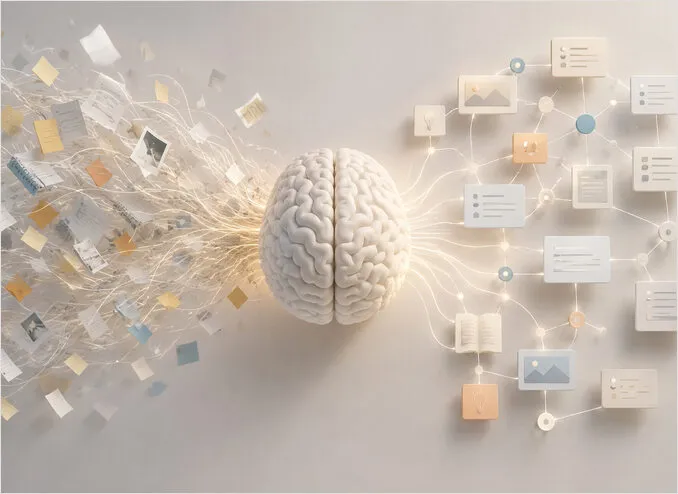 Capture, organize, distill, express: the loop that separates systems from basements
CODE: The Operating Loop
Capture saves ideas with future energy — surprising, reusable, unresolved, or work-tied — asking “useful again in a different context?” rather than “keep forever?” Organize optimizes retrieval friction over taxonomy perfection: actionability buckets (projects, areas, resources, archives) beat decaying category trees. Distill converts highlight dumps into recognizable ideas — claims worth testing, reusable fragments — the skipped step that makes the method work, formalized as atomic evergreen notes improving on revisit. Express closes the loop into articles, designs, memos, and docs; without output there’s no pressure test, no learning, just backlog.
What It Isn’t
PKM names the wider field — cognitive, informational, social, learning competencies — while a second brain is one opinionated implementation inside it (capture-to-expression workflow plus actionability organization). Against neighbors: wikis stabilize shared truth and fumble half-formed private thinking (their home is settled knowledge); RAG retrieves at query time without preserving interpretation (complementary machine layer); the fuller split lives in PKM vs RAG vs Wiki vs Memory. Storage is cheap, retrieval expensive, synthesis compounding — folders of markdown are no more a second brain than source piles are a product.
Tools Matter Less Than Workflow
Obsidian pairs local markdown with links, backlinks, and graph navigation — file ownership plus structure, hard to ignore for technical users. Logseq runs local-first outlines: journals, bullets, nonlinear fragments accumulating before connecting. Notion unifies docs, databases, and team wikis with links and AI search across workspaces. All three can host a second brain and all three can fail at it — weak workflow in a powerful tool stays weak, clear workflow in a simple tool compounds. Judge sync plumbing too: private peer-to-peer file sync keeps vaults consistent across machines without cloud subscriptions.
Three Traps and the Evolution Curve
Collecting everything destroys salience (signal-thin archives), over-structuring converts thinking into grooming (folders, tags, dashboards consuming the cognition they should serve), and never expressing accumulates without compounding (fragments must become artifacts). Survive those and the system compounds: early handfuls of notes start cross-linking — meeting to decision, draft to half-idea, bug to product thread — until value migrates from notes to relationships, archive to evolving context map.
AI: Accelerator, Not Owner
AI summarizes troves, surfaces cross-workspace relations faster than manual search, and drafts outlines, framings, and action items — but predicts relevance from patterns while meaning stays human: priorities, context, taste. The durable braid is human-curated durable context plus machine acceleration over the archive, formalized architecturally as LLM Wiki: ingest-time compiled structure so queries stop re-deriving synthesis from raw notes. Judgment stays human; the model never owns the vault.
Summary
Stop using your first brain as cold storage. Capture sparks, organize for retrieval, distill to reusables, express to learn — across whatever tool survives your workflow, with AI accelerating and never owning. The framework outlives every app because the gap it designs for — capture to need — outlives them too.
What does your second brain run on — and which phase leaks most, capture, distill, or express? Share the setup in the comments below!