Kanban in Hermes: Dispatching Agents Without DDoSing Your Own GPU
Hermes Agent ships a durable Kanban board whose dispatcher happily promotes every ready task at once — fine against elastic cloud APIs, a self-inflicted denial of service against one small GPU cluster. Uncapped promotion floods the gateway with concurrent requests and turns throughput into queueing, thrashing, and timeouts.
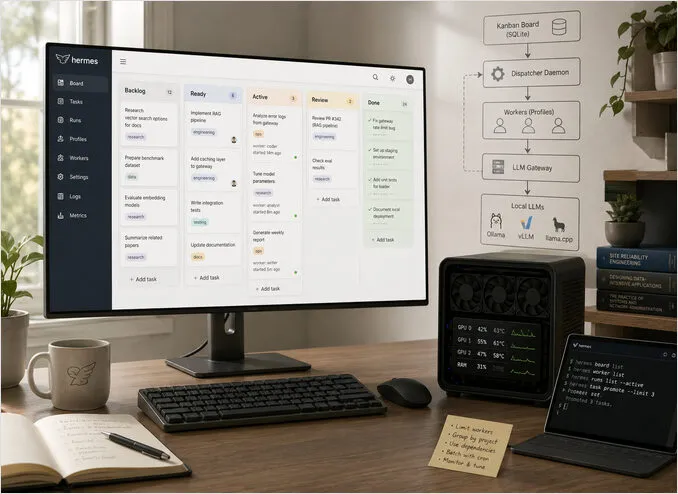 Durable board, isolated profiles, dispatcher: powerful until promotion outruns the cluster
How Dispatch Works — and Where the Cap Isn’t
Three layers: the board (durable SQLite state for tasks, columns, relations, history), workers (profiles in isolated workspaces), and the dispatcher (long-lived process scanning for dispatchable cards, claiming atomically, and spawning runs against Ollama, vLLM, or llama.cpp endpoints). Cards start in backlog or ready; the dispatcher pulls and launches.
The trap, found by reading the dispatcher source: hermes kanban dispatch caps only new spawns per pass (--max 2 limits that pass, not total running tasks), and no max_active_tasks config is consulted on that path — unbounded promotion limited only by ready-queue size. Gateway-embedded dispatch and a forced daemon against one board race on claims; a down gateway silences dispatch until service returns, then bursts. Verify with process listing (pgrep for gateway versus daemon), config key inspection, and ready/running queue counts. Config wires exactly two keys — gateway-embedded dispatch toggle and tick interval — so active-task control must come from explicit cadence plus dependency modeling.
Strategy 1: Dependency Chains for Sequential Flows
Pipelines sharing artifacts, migrations, same-store batch jobs: model parent-child links so children become dispatchable only on parent completion. A small CLI helper script creates the chain (parent ingest, child report, child publish), then low dispatcher limits pull tasks one by one without ever breaching concurrency caps. Deterministic by construction.
Strategy 2: Cron with a Running-Aware Cap
For deterministic pacing, wrap dispatch in a host-cron script that counts running tasks first and dispatches only remaining slots:
#!/usr/bin/env bash
set -euo pipefail

MAX_PARALLEL="${MAX_PARALLEL:-2}"

running_out="$(hermes kanban list --status running)"

if [[ "$running_out" == *"(no matching tasks)"* ]]; then
  running_count=0
else
  running_count="$(printf '%s\n' "$running_out" | wc -l)"
fi

slots=$(( MAX_PARALLEL - running_count ))

if (( slots <= 0 )); then
  echo "Already at limit running=$running_count max=$MAX_PARALLEL dispatch skipped"
  exit 0
fi

hermes kanban dispatch --max "$slots"
Schedule per minute via crontab with explicit PATH (cron environments are minimal — use absolute binary paths), writable log directories, and crontab -l verification. Sub-minute cadence comes from a loop wrapper (four passes per minute with sleeps) guarded by flock against overlapping runs. The cap only governs dispatches through this script — disable gateway-embedded dispatch or it promotes independently. And skip internal LLM-driven cron: burning model calls to run shell schedules while busy doing real work is backwards.
Monitor, Tune, Know When Kanban Fits
Watch gateway metrics (rate, latency, errors, token throughput), node health (GPU utilization, VRAM, CPU, RAM), and board shape (backlog, ready, active, done). Raise concurrency gradually: rising latency at flat throughput, growing timeouts, or long-tailed active tasks all mean roll back to the last stable config and keep it default. Kanban earns its place with long-lived research and engineering backlogs, multi-profile collaboration, restart-surviving workflows, and dashboard triage by humans — single runs spawning temporary helpers stay simpler with built-in delegation tools. When named profiles grow into real coordination topologies, the patterns in multi-agent orchestration describe what dispatch alone can’t. For the serving runtimes underneath, the Ollama to vLLM migration guide covers which backend matches shared-service load.
Summary
Board for durability, profiles for isolation, dispatcher for flow — with promotion capped by measured slots, dependencies for sequences, cron for pacing, and metrics for truth. Configured that way, Kanban stays responsive while the gateway and hardware stay alive.
Running background agents against self-hosted models — what caps your dispatch? Share the setup in the comments below!